Product Overview
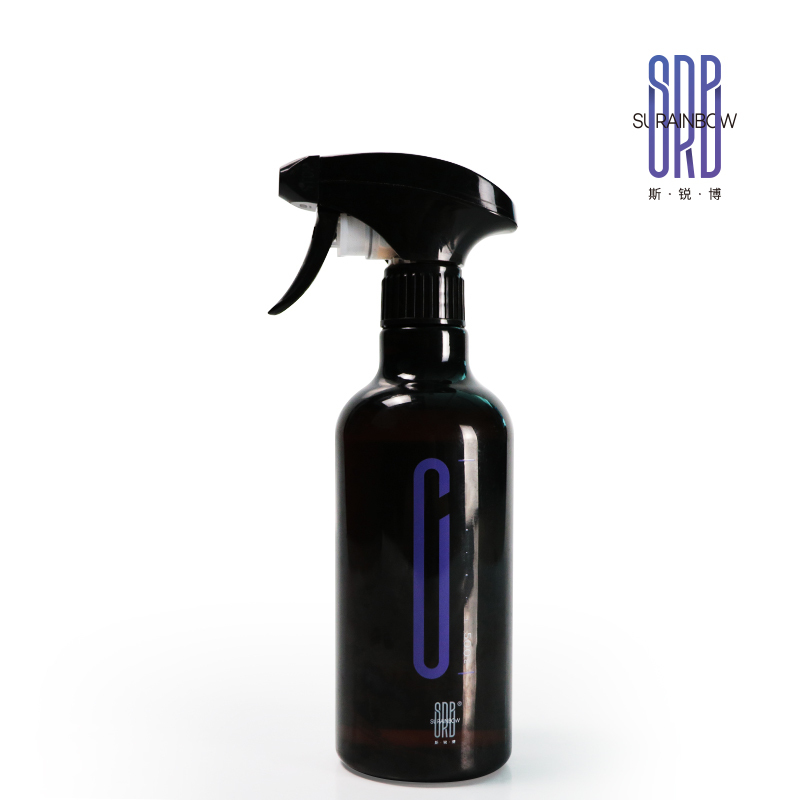
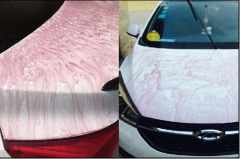
It goes on neat, straight from the bottle, so there is no mixing at the bay and nothing to decant between jobs. The work it does is specific: brake iron powder, paint iron powder, carbon powder and rust. These are the particles that embed in clear coat and turn into brown speckling on white and silver paint, and the formula is built for a strong decomposition reaction on stubborn deposits rather than a light surface clean. In a full wash, the car wash iron remover stage comes after the pre-rinse and before any contact wash or clay. Working in that order lets the chemistry dissolve the metal particles first, so the mitt or pad is not dragging them across the paint. It is non-corrosive to glass and paint, and it is made to be used with a high pressure washer: apply, let it work, agitate the tight areas, then rinse the residue away before it dries on the panel.
Specifications
| Product Name | Iron Powder Removing Cleaning Agent |
| Model | C87 |
| Volume | 500ml |
| Function | Remove Iron powder rust from Car Paint and Wheel Rim |
| Application | Car Paint and Wheel Rim |
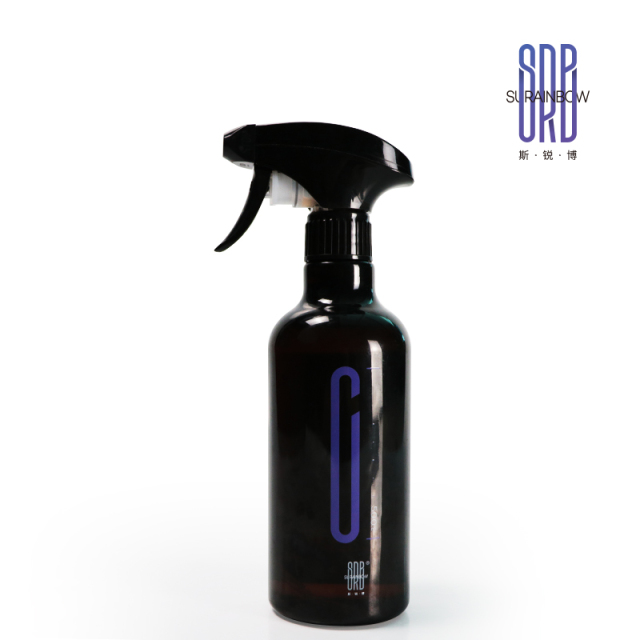
| Format | Iron remover 500ml, ready-to-use liquid in a trigger-spray bottle |
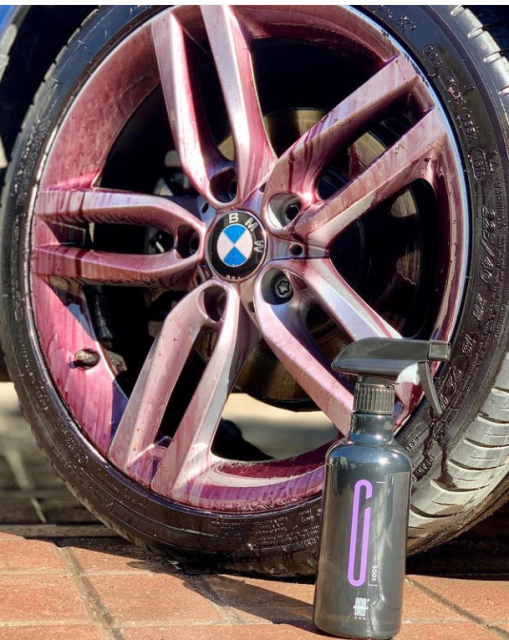
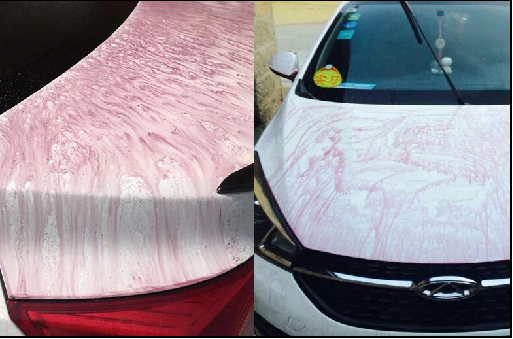
| Indicator | Colour indicator to judge working time |
| Packing | 24 bottles in a carton |
| Rinse | High pressure water |
| Safety | Non-corrosive to glass and paint |
Wheel Rims and Painted Panels
- Wheels are the main event.
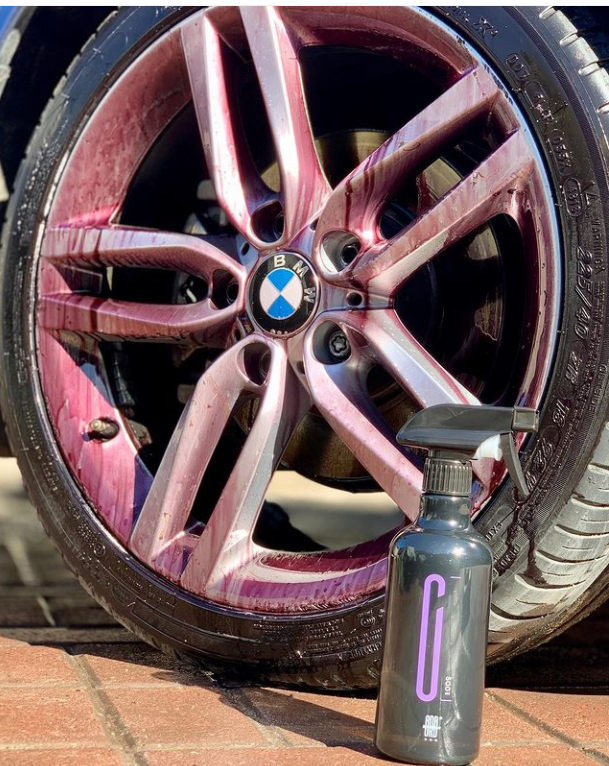
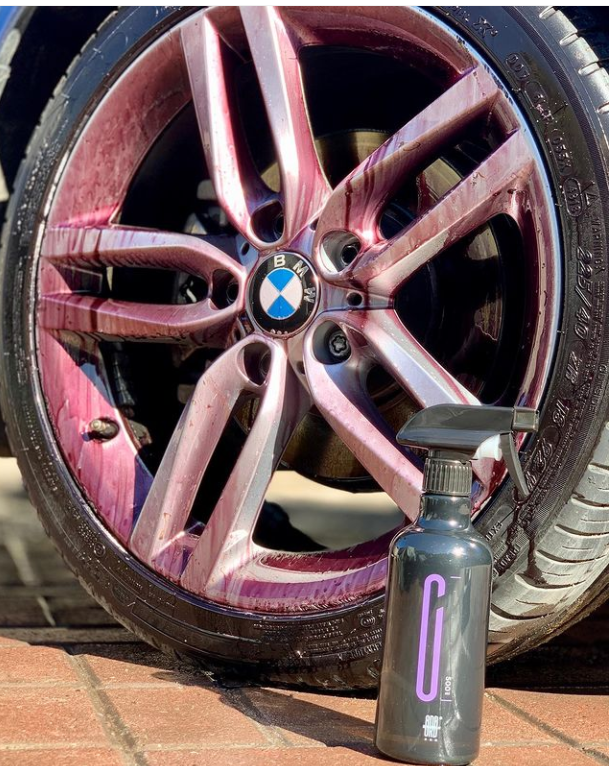
- A brake dust iron remover earns its place on barrels and spokes that go brown within weeks of a normal wash, and on the inner face where the caliper throws dust.
- Keep wheel tools separate.
- Use a dedicated brush or mitt on rims and do not carry the same one onto paint, so loosened metal particles are not spread across the panels.
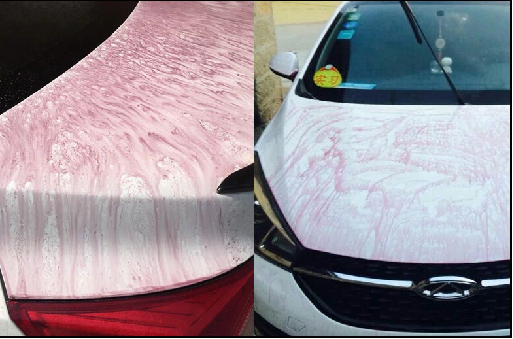
- On paint, a car paint iron remover is aimed at the lower third of the car: sills, door bottoms, the leading edge of the rear bumper and the boot lid, plus the mirrors on cars that live outside.
- As a car iron powder remover it also lifts rust bloom around stone chips and older repairs, but test an inconspicuous area first on a freshly painted or repaired panel.
- Glass and trim can be oversprayed without concern because the formula is non-corrosive to glass, though a rinse is still the tidy way to finish a section.
- Plan for the protection step afterwards.
- Decontaminating resets the surface, so if the car carries a wax or sealant, top it up after the rinse.
Application Steps
- Pre-rinse the vehicle and move it into shade or indoors.
- Start with the wheels.
- A brake dust iron remover needs the longest dwell on the barrel, the spokes and behind the caliper, where brake powder collects fastest.
- Then move to the paint.
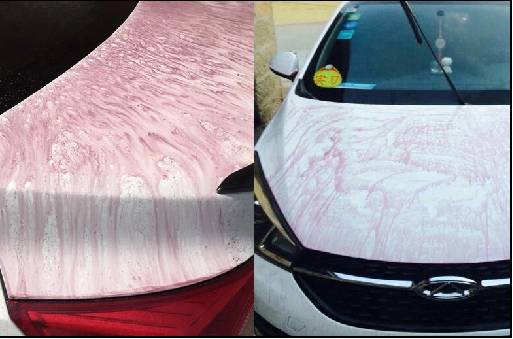
- As a car paint iron remover it goes on the lower doors, sills, boot lid and rear bumper — the panels that collect airborne fallout as the car is driven.
- Leave it to work.
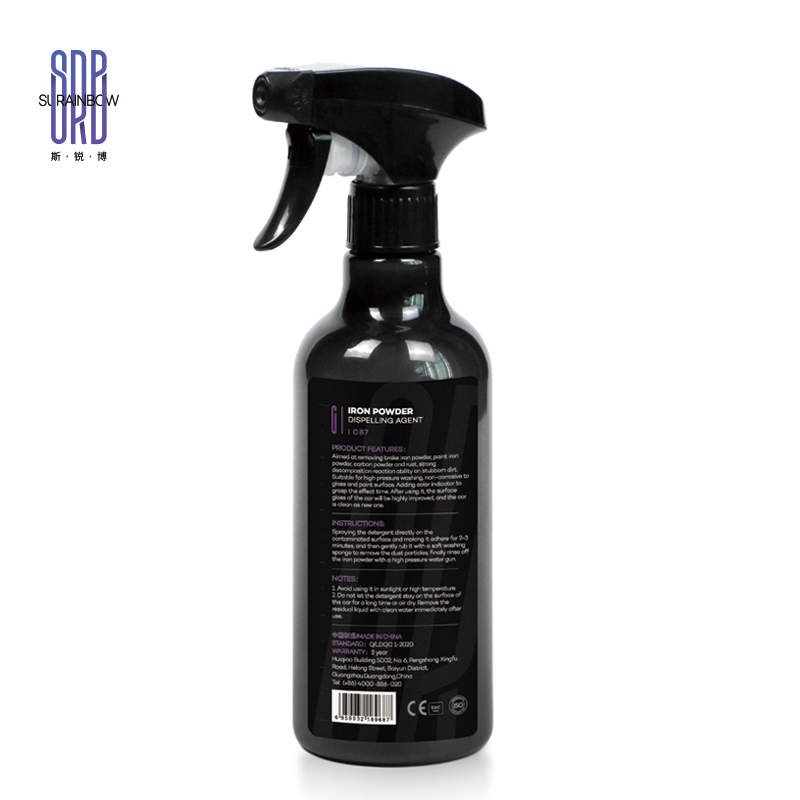
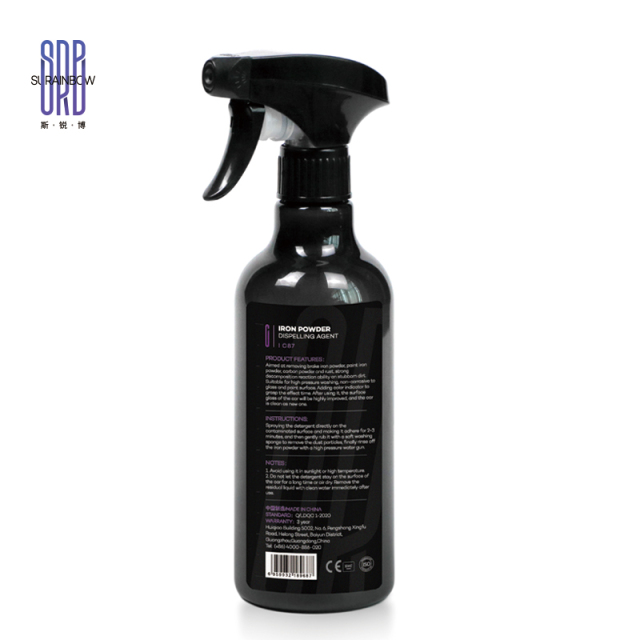
- The label gives 3-5 minutes for a normal pass and 5-10 minutes where the deposit is heavier; judge the section by whether the surface is still wet rather than by the clock alone.
- Agitate the stubborn spots with a soft brush.
- The label asks for a soft brush and a repeat application rather than hard scrubbing.
- Repeat on the same section where specks are still visible after the first pass, instead of increasing the strength of the mix.
- Rinse with a high pressure water gun, working from the top down, and never let the car wash iron remover dry back onto the panel.
- Check the panel in good light.
- Treated areas come back noticeably brighter, so anything left behind is easy to see and worth a second pass.
Colour Indicator and Working Time
The formula carries a colour indicator, and its job is to show working time rather than decorate the bottle. On a car iron powder remover that reacts with metal particles, the indicator is what separates a rinse that is too early from one that is too late.
Spray a section, watch the surface, and rinse while it is still wet. A panel that has started to dry is a panel that has stopped working the way it should.
Heat, wind and direct sun shorten the window considerably, which is why the label asks for shade and a cool surface. Work one panel or one wheel at a time rather than spraying the whole car and then chasing it.
The indicator is also the quickest way to train a new technician on a heavily contaminated car, where the first pass takes most of the fallout off and the second pass confirms the surface is genuinely clean.
Safety, Storage and Handling
- Use it in a ventilated place.
- The label asks for ventilation, and a closed bay with no extraction is not the place for a reaction-based cleaner.
- Avoid sunlight and high temperature.
- Work on a cool surface in shade, and never let the product dry on the panel.
- Do not add the detergent to water.
- It is supplied ready to use, and diluting it in a bucket changes how it behaves on the surface.
- Keep it off your skin and out of your eyes.
- If it gets into the eyes, rinse immediately with clean water and keep rinsing.
- Store bottles upright with the trigger closed, away from direct sun and out of reach of anyone who should not be handling chemicals.
- Check the batch and the quality period printed on the bottle before a season starts, and rotate stock so the oldest cartons ship first; that matters more on iron powder remover wholesale stock than on a few bottles on a shelf.
Packing, Documents and Ordering
- Labels and cartons: bottle, label and carton artwork can be proofed before bulk, which is what buyers running an iron powder remover wholesale line usually want settled first.
- Private label: as an iron remover manufacturer we take on OEM and private-label work, from label and artwork approval through to a sealed sample kept as the bulk reference.
- Sampling and approval: ask your sales contact about sample availability and agree what you will evaluate — panel test, wheel test, label proof — so the approved version is written down before the bulk order is released.
- Documents: SDS/MSDS, CoA, GHS label information, commercial invoice and packing list can be prepared for the destination market.
- Confirm the exact set your importer needs.
- Stock and shipping: In stock and fast shipping is how we handle repeat lines, and as a car iron remover supplier we would rather ship from stock than keep your reorder waiting on a production run.
- Terms: MOQ, pricing, payment method and the balance-before-shipment schedule are quoted per product and per destination — confirm them with your sales contact once the volume is clear.
- After-sales and traceability: report leakage, shortage or a quality concern with the batch number, the affected quantity and photos — within 7 days of receipt for packing issues and within 30 days for product quality — so it can be checked against the retained sample.
Scale & Supply Capability
SURAINBOW is run by Guangzhou Liangdian Automotive Supplies Co., Ltd., an iron remover manufacturer and factory-trade operation set up in Guangzhou in 2010, now 50 people strong. Sixteen years in car care have given us a one-stop supply position: our own SURAINBOW lines are held in stock for fast shipping, and an associate factory with modern production equipment and an established quality management system keeps replenishment moving. We take OEM and ODM work and our R&D team develops to your specification. Buyers in the Middle East, the United States, Southeast Asia, Europe, the UK, Russia, Africa and Australia already order from us.
FAQ
Can I use it on painted panels, or is it only for wheels?
Both, though the two surfaces behave differently. As a car paint iron remover it lifts the fine metallic speckling that shows on light colours and on horizontal panels; on wheels it works through a much heavier build-up. Treat them as separate passes and rinse each one before it dries.
Where does it fit into a wash routine?
Treat it as the car wash iron remover step: pre-rinse first, apply after the worst of the road dirt is off, then pressure-rinse before you touch the paint with a mitt or clay. If polishing or coating follows, run this stage first and let the surface dry fully.
How far does one bottle go?
The iron remover 500ml bottle is the working size — one bottle in the hand rather than a drum to decant into a sprayer. Consumption depends on how contaminated the vehicle is and how much of the wheel you treat, and on neglected wheels it is normal to go over the surface twice.
Does it take rust off as well as brake dust?
Yes. As a car iron powder remover it is formulated for rust bloom as well as the metallic fallout that brakes and traffic leave behind. Rust that has broken through the paint will not come back to a smooth finish, but the staining around it lifts, which is what makes the panel ready for polish.
What about wheels that have not been cleaned in months?
Give a brake dust iron remover dwell time and a second pass. It works by reaction rather than by scrubbing, so spray, wait, agitate the tight areas with a soft brush, rinse, and repeat the section where the deposit is thick.
Is this the same formula professional detailers use?
It is the same C87 formula we ship to detailing bays and importers alike. As a car iron remover supplier we keep to one specification, so the liquid you test on your own panel is the liquid that goes into the carton.
Can it carry our own brand on the label?
Yes. As an iron remover manufacturer we take on private-label and OEM work: bottle, label and carton artwork, a proof approval step, and a sealed sample kept as the bulk reference. Send your artwork and the label content your market requires with the enquiry so the proof can be checked in one round.