Product Overview
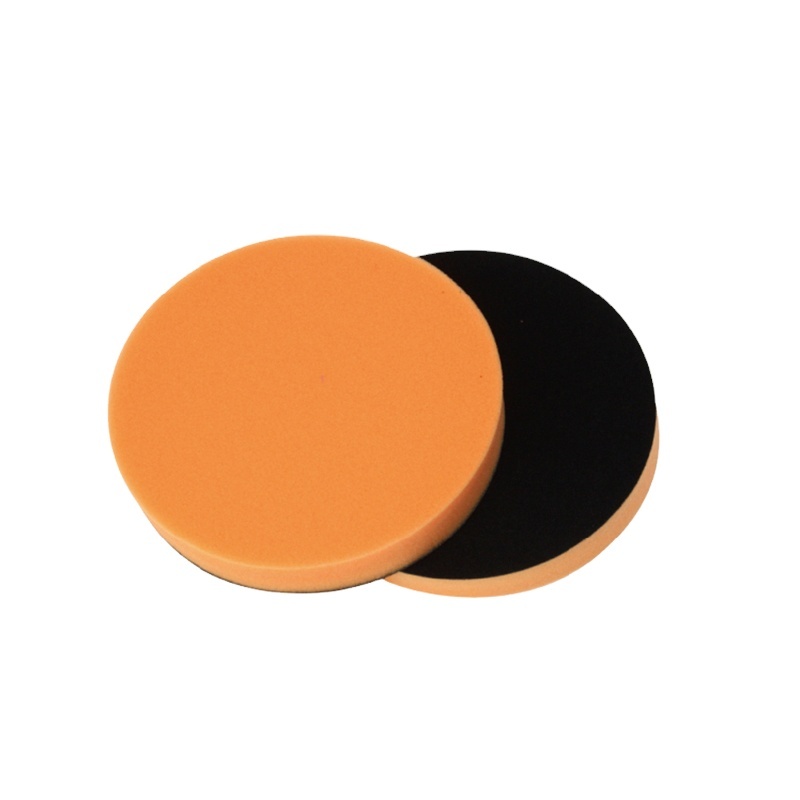
This is a round foam polishing pad that fits on a machine backing plate and carries polish, compound or wax onto painted panels. Detailers, wash bays and resellers buy pads as consumables rather than as a one-off purchase, because a pad is retired long before the bottle it is used with runs out. For an importer it is the simplest way to round out a car care products order that would otherwise be liquids only. In daily use the pad is fitted to the plate, primed with a thin smear of car polish, spread at low speed and then worked across one section at a time. Foam holds product at the face instead of letting it fly, so the pad stays loaded and the panel stays tidy. Waxing the car and cleaning the paint are the two jobs the listing names, and they describe the same motion at different speeds: slow passes with a compound to correct the surface, then a lighter pass with car waxes and polishes to protect it. Nothing is needed to change one: the pad pulls off the plate by hand and presses back on, and it stores in the same tote as the rest of a bay's cleaning tools for car work rather than in the machine cupboard.
Foam Grades & Face Construction
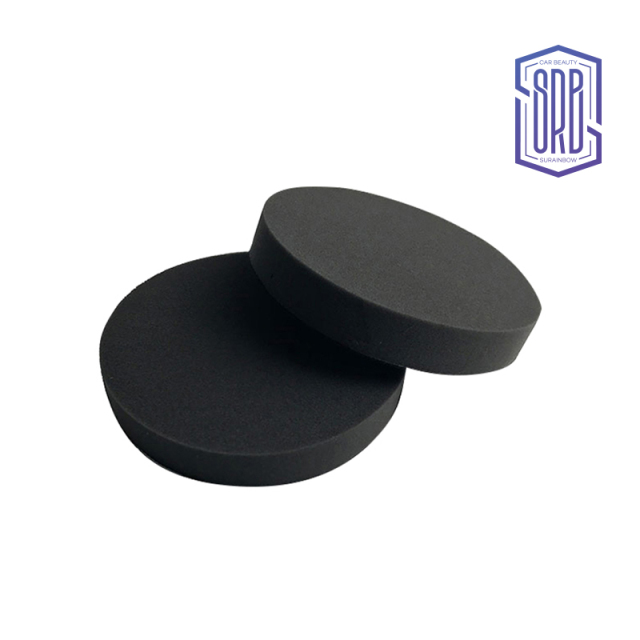
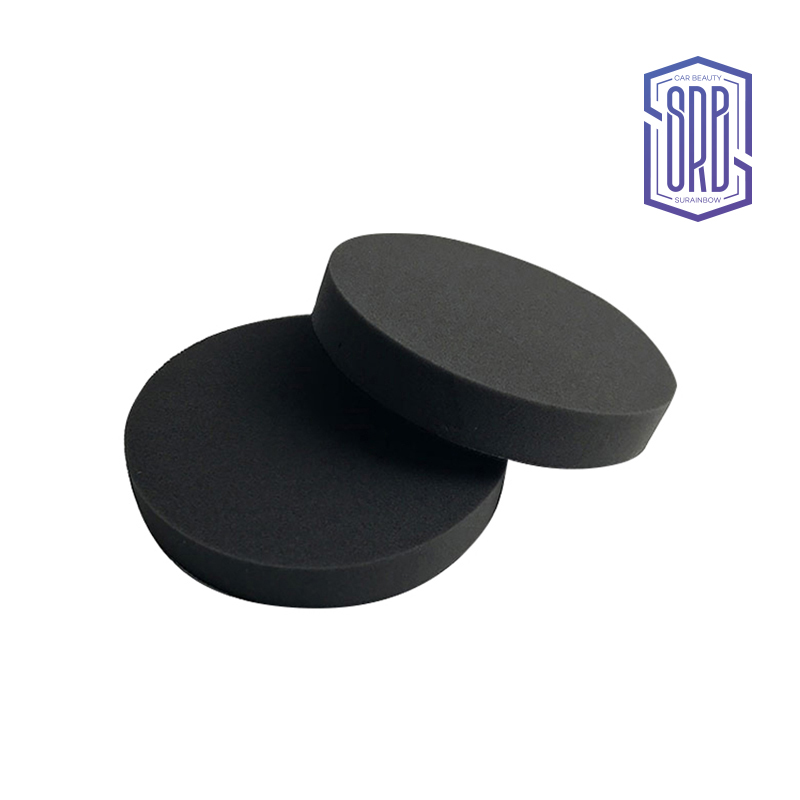
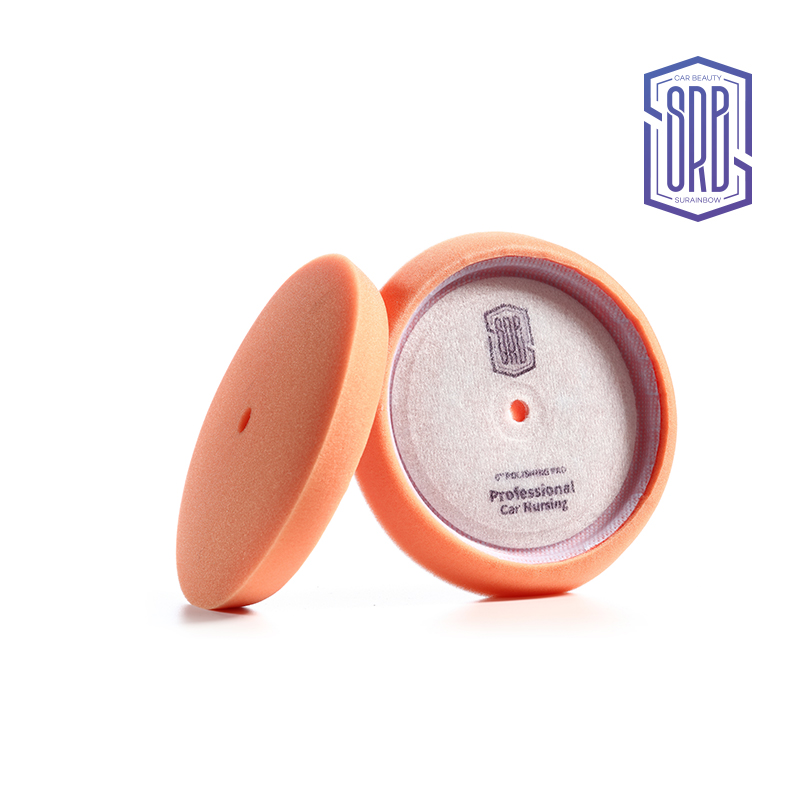
- Dense foam body.
- The pad holds its shape under machine pressure, so the face stays flat against the panel instead of curling at the edge of a bonnet or a door skin.
- Soft working face.
- The foam compresses slightly as it moves, which lets the abrasive in a polishing compound for car scratches cut evenly across the section rather than in stripes.
- Flat circular profile.
- Full contact across the disc means the panel is worked at one rate, which is what keeps a machine polish from leaving a visible track behind the pad.
- Smooth, matte surface.
- An even face releases spent product instead of holding it, and it does not grab when the pad is tilted into a curve.
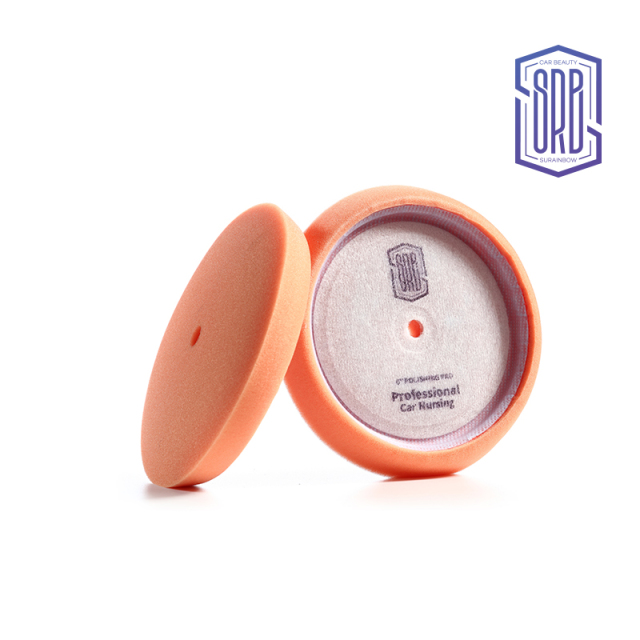
- Printed backing.
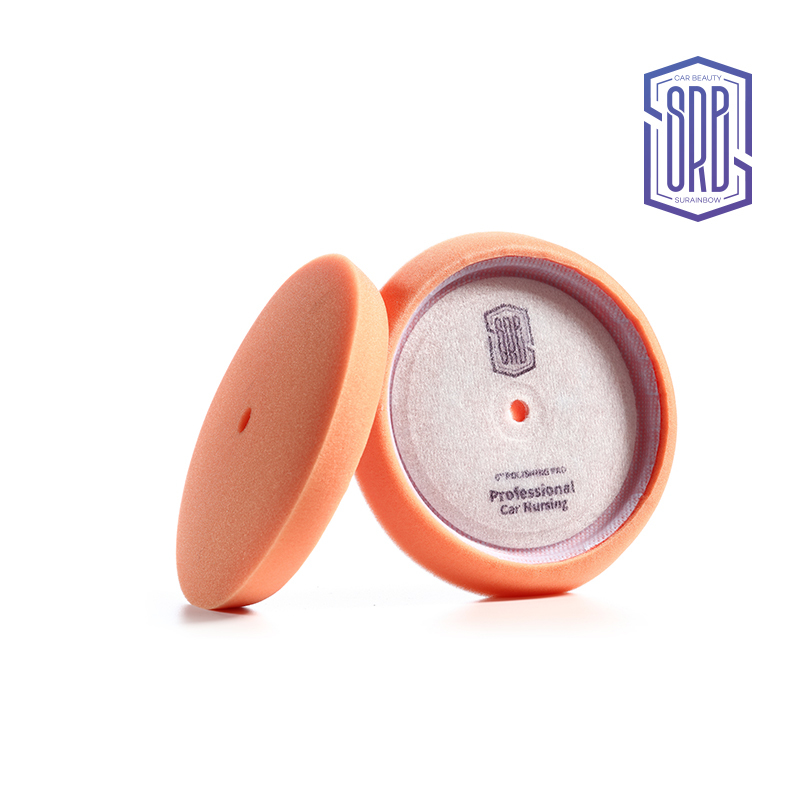
- The reverse carries the SURAINBOW mark, so stock is easy to check at the counter and again in the warehouse.
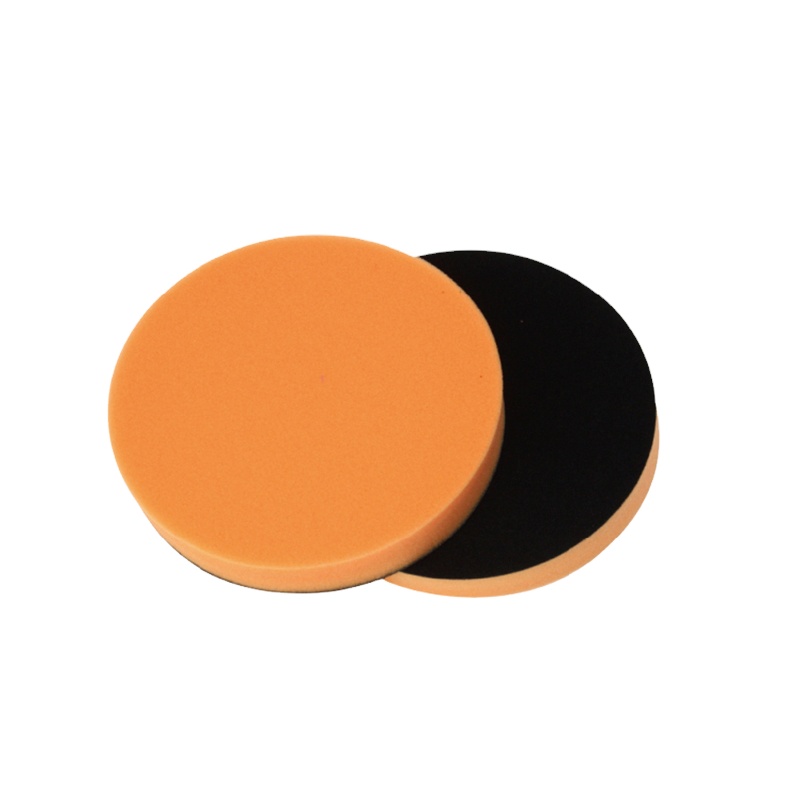
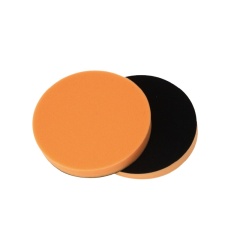
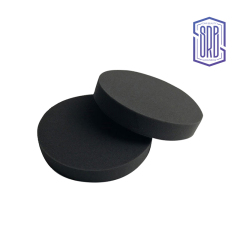
- Colour-coded faces.
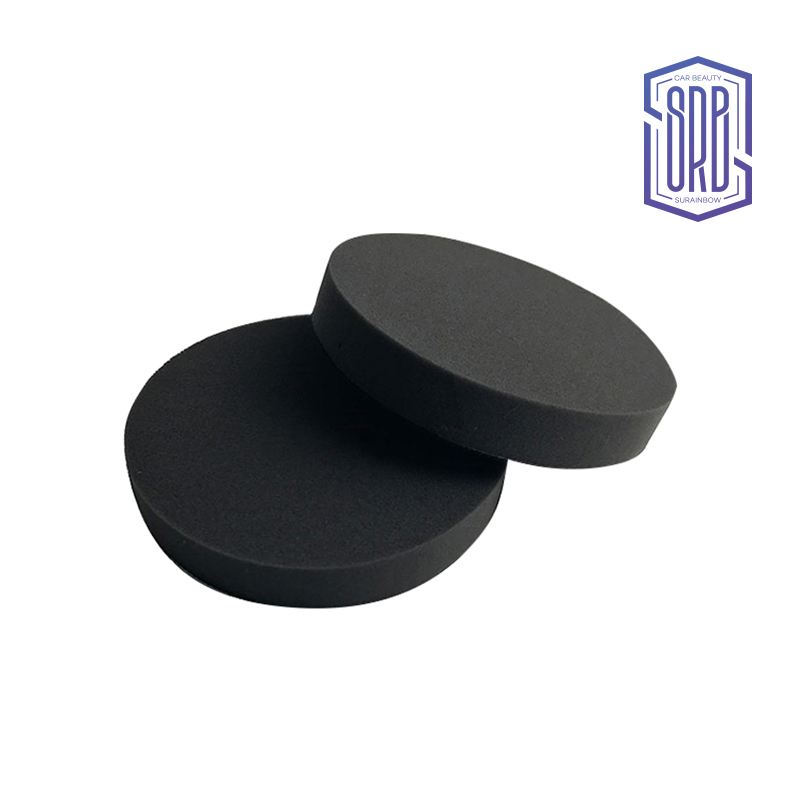
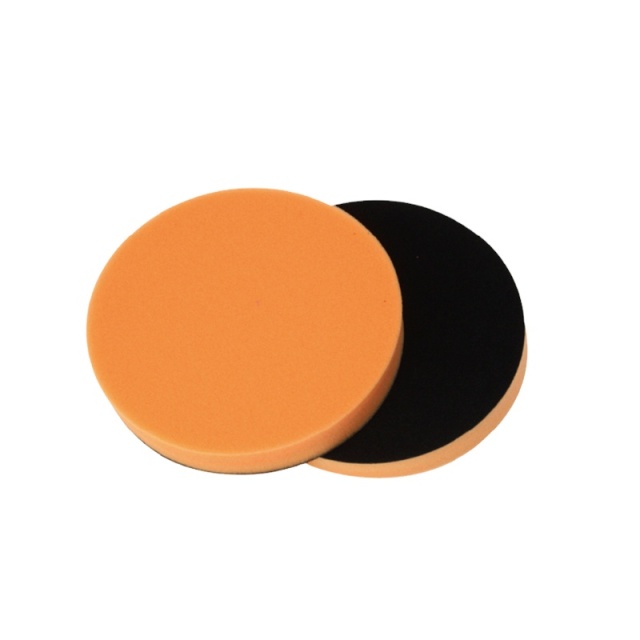
- An orange face and a black face on the same disc give a bay a visual split between grades, and a pad that has wandered into the wrong bin among the other car care supplies is spotted quickly.
Machine Fit & Backing System
The pad attaches through its loop backing to the hook face of a machine backing plate, so a change of grade takes seconds and no tools. Match pad and plate diameter: foam that overhangs the plate has no support behind it, folds at the edge and runs unevenly across the panel. The centre hole is a locating point. Line it up with the centre of the plate and the pad seats concentric, which keeps the machine balanced at speed and stops the pad creeping off-centre during a long pass. The same pad runs on a rotary and on a dual-action machine; what changes is technique, not fitting. A rotary works on a single axis and rewards a light touch near edges and swage lines, while a dual-action orbit is more forgiving for an operator who is still learning the machine. Tell us the backing plate size and the tool you run and we will confirm the diameter on your order. Diameter is the one detail buyers most often get wrong when they reorder without checking the machine in front of them. Distributors usually file them with the cleaning tools for car care rather than with the equipment, because they are ordered on the same sheet as compounds, waxes and shampoos. These are pads only — a backing plate is a separate part, and so is a wool cutting disc.
Polishing Sequence in the Bay
- Wash and decontaminate first.
- Polishing over bonded dust and tar grinds dirt into the paint, so the panel is washed and clayed before a pad touches it.
- Fit the pad and prime it.
- A thin line of product worked into the face at the lowest speed loads the foam evenly, so the first section cuts like the last; with most car care supplies this takes seconds, and skipping it shows up as an uneven finish.
- Cut the defects.
- With a car polishing compound on the firmer face, work a small section in overlapping passes and keep the machine moving so heat does not build in one spot.
- Spot-treat isolated marks.
- Where a scratch is local to one panel, a polishing compound for car scratches on a small pad keeps the repair inside the damaged area instead of polishing a whole side of the car.
- Refine the finish.
- Switch to the softer face and a finer car polish to clear the haze the cutting step leaves, then wipe the section down and read it under an inspection light.
- Finish with protection.
- A fresh pad and a thin coat of sealant or wax closes the job; car waxes and polishes laid down by machine go on thinner and more evenly than by hand, and a clean microfibre wipe afterwards confirms the finish is level.
Pad Care & Storage
- Wash and reuse.
- A foam pad is one of the few cleaning tools for car detailing that is rinsed and put back into rotation, so warm water and a thumb worked across the face after each panel lifts spent product before it sets.
- Keep water off the backing.
- The loop layer is what holds the pad to the plate; soak it and the grip softens, so rinse the face only and wipe the back dry.
- Dry face-down, away from heat.
- A pad left in the sun or on a radiator can soften and take a set, while air-drying face-down lets water drain out of the foam.
- Store flat and covered.
- A dust-free bin keeps grit off the face, and nothing heavy on top — a pad stored under pressure will not sit flat on the plate again.
- Date the carton and rotate.
- Pull from the front of the shelf and use the oldest pads first, so a pad does not sit at the back of the store for years behind newer car care supplies and lose the face quality you paid for.
- Keep a face per step.
- A pad that has carried compound should not go back into the finishing wax; separating the two is the simplest way to keep car waxes and polishes spreading evenly.
- Wipe the plate before fitting.
- Dust and dried compound on the backing plate stop the loop layer gripping properly, and a pad that slips on the plate is a common reason a face wears out early.
Specifications
| Property | Value |
|---|
| Product name | Car polish pad |
| Model | T-602A |
| Type | Polishing pad, washer |
| Material | Foam |
| Backing | Hook-and-loop |
| Use | Waxing and cleaning car paint |
| Weight | 0.5 kg |
| Shelf life | 3 years |
| Packing | 100 pcs per carton |
| OEM | Accepted |
| Brand | SURAINBOW |
| Place of origin | Guangdong, China |
Sampling & Bulk Programme
- Send the brief.
- Distributors, detailing chains and car cleaning products manufacturers all start the same way: the machine and backing plate size, how many grades a bay runs, and whether the carton carries the SURAINBOW mark or your own artwork.
- Test a sample on a real panel.
- Pads are judged by how they cut and finish rather than by how they look in a bag, so confirm the sample scope and any sample or courier charges with your sales contact before dispatch.
- Approve and seal.
- Keep the approved pad as the physical reference for the bulk run, so face feel and cut can be compared against something you can hold rather than against a description.
- Proof the packaging.
- Carton artwork, label copy, barcode data and shipping marks are signed off before print, and the approved proof governs the run.
- Produce against the sealed pad.
- The bulk run is checked against the approved pad and the approved carton before release, and a batch that feels different from the reference is caught before it is packed.
Ordering & Delivery
| Property | Value |
|---|
| Availability | In stock and fast shipping |
| Range | Polishing pads within the SURAINBOW car care products line |
| Branding | SURAINBOW label, or your own artwork and carton under OEM |
| Minimum order | Confirmed per item on the quotation |
| Payment | Method and schedule confirmed on the commercial offer |
| Sourcing | Pads, compounds and waxes quoted together from one car wax manufacturer |
| Documents | Commercial invoice, packing list and product documents confirmed per shipment |
| Dispatch | Confirmed after balance payment and final inspection |
| After-sales | Packing issues reported within 7 days of receipt, quality concerns within 30 days |
| Traceability | Batch records and retained samples held against the order |
| Shipping method | Air, sea and courier options confirmed with the quotation |
Scale & Supply Capability
SURAINBOW is run by Guangzhou Liangdian Automotive Supplies Co., Ltd., a factory-trade operation set up in Guangzhou in 2010 and now 50 people strong. Sixteen years in car care have given us a one-stop supply position: our own SURAINBOW lines are held in stock for fast shipping, and an associate factory with modern production equipment and an established quality management system keeps replenishment moving. We take OEM and ODM work and our R&D team develops to your specification. Buyers in the Middle East, the United States, Southeast Asia, Europe, the UK, Russia, Africa and Australia already order from us.
FAQ
Can the pads be used for waxing as well as polishing?
Yes. A clean face loaded with wax or sealant is the last step of the same job, and it is the point where most car care products perform at their highest level, because foam spreads a thin, level coat that needs almost no buffing afterwards. Use a face that has not carried compound, so spent abrasive does not end up in the wax.
How do I know when a polishing pad needs replacing?
When the face glazes over, the edge starts to crumble, or the pad no longer sits flat on the plate. A glazed face stops cutting and starts heating the panel, which costs more in product and time than a new pad; retire it as soon as the cut stops being consistent from one section to the next.
Can the pads be used by hand?
For spot work, yes: a small pad with a polishing compound for car scratches, worked in short passes with light pressure, keeps the repair local. On a full panel a machine is what the pad is made for, because hand pressure cannot hold the face flat and moving at a consistent rate across the surface.
Can we have our own logo on the pads and the carton?
The backing can carry your mark and the carton can be printed with your own artwork; confirm the scope with your sales contact and send the artwork, label text and barcode data with the brief. Brand owners and car cleaning products manufacturers often take this route when the pads are going into their own range.
Do the pads suit tight areas such as pillars and bumpers?
A full-size disc is awkward on a pillar or around a mirror cap, where the panel curves away from the face. A smaller pad from the same range covers those areas with the same foam and the same hook-and-loop fitting, which is why many bays keep a small set beside their regular discs.
Will the pads work with the compounds and waxes we already stock?
Foam is a neutral carrier, so a car polishing compound, a finishing polish or a liquid wax can all be worked with a foam face; the pad does not dictate the chemistry. Check the product's own instructions for a recommended pad, and test one panel before running a full vehicle.