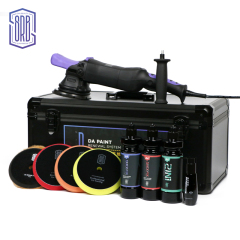
Product Overview
Heavy, visible scratches — along with the orange peel, fisheye and 1500-2000 grit sanding tracery that usually come with them — are what a paint room spends most of its polishing hours on. This compound is built for that work: a one step polishing compound with a strong cut, made for the panel that has to go from damaged to presentable inside a working day.
In practice it is the panel that arrives after a repair, or after years of washing with a dirty mitt: a door skin, a bonnet, a wing mirror cap, a scuffed bumper corner. Paint rooms, auto beauty studios and detailing bays reach for it where the defect is deep enough to catch the light from across the workshop but the clear coat underneath is still sound. Set against a traditional routine of heavy compound, refining polish and finishing agent, it collapses three passes into one.
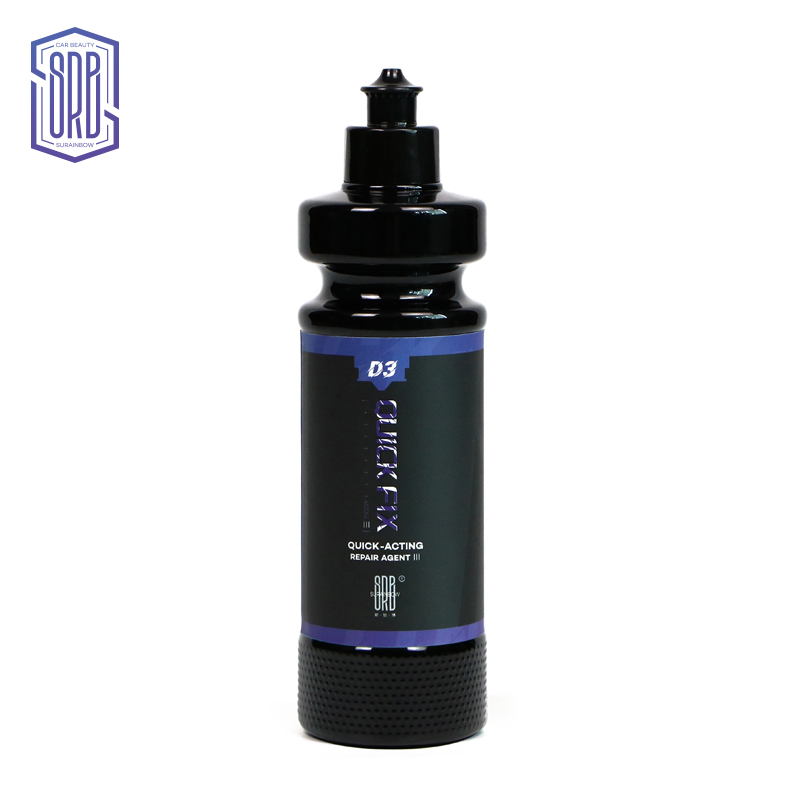
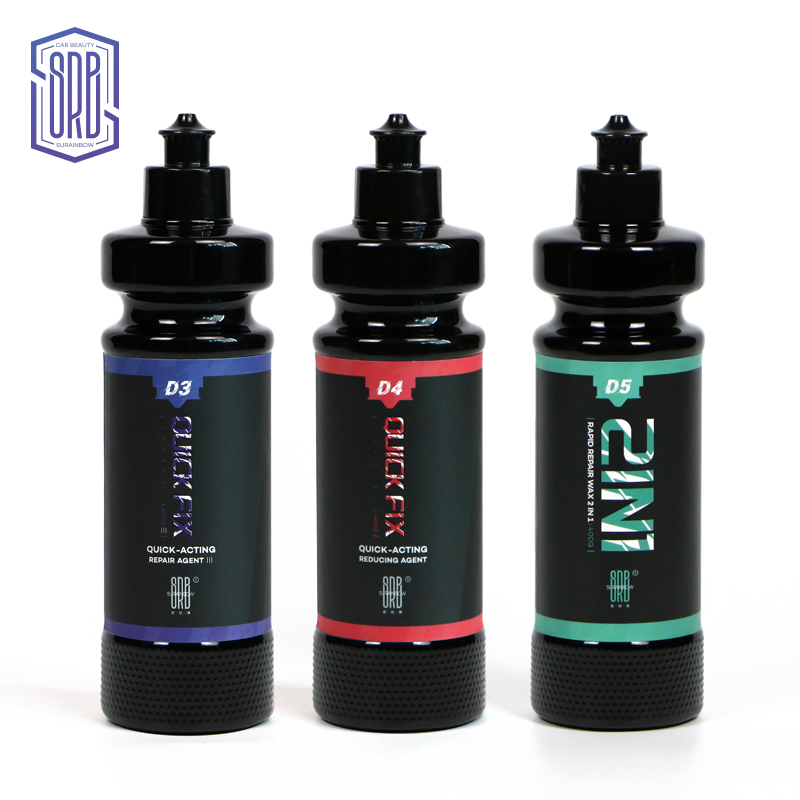
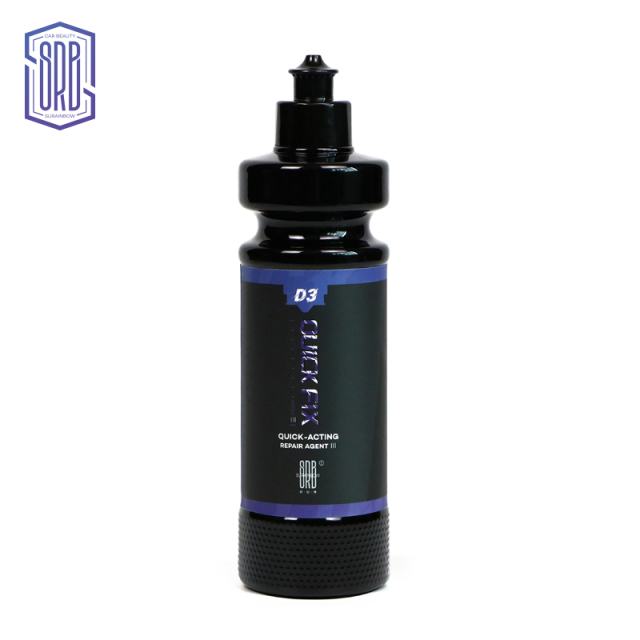
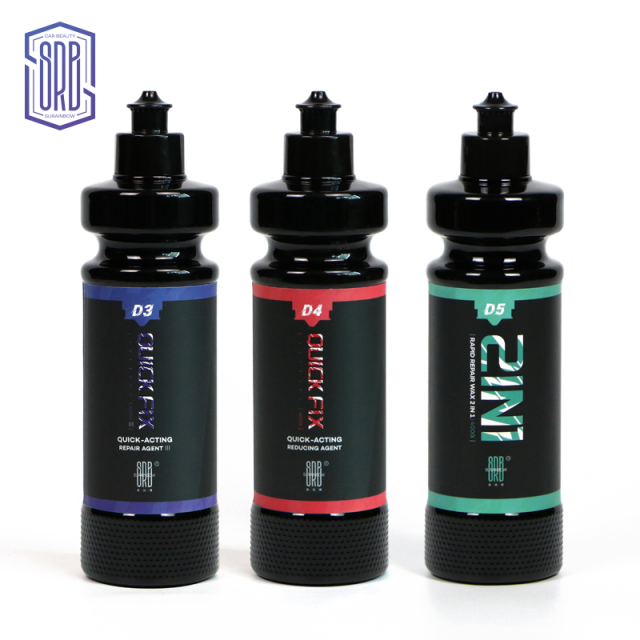
SURAINBOW is a strong cutting polish compound supplier, making the compound in Guangzhou and supplying paint rooms, detailing chains and distributors. It is filled into a black dispensing bottle with a narrow nozzle and a textured base, so a technician can dose material onto the pad by the grain and set the bottle down on a wet trolley without it sliding away.
Strong cut where the defect is: this behaves like a heavy car polishing compound rather than a finishing polish, levelling heavy-to-moderate scratches, orange peel and 1500-2000 grit sanding marks, so a damaged panel does not need a separate heavy-cut stage first. Cut and gloss in the same pass: the abrasive keeps working while the finish comes up behind it, which is what one-step mirror means on the shop floor — the technician stays on the panel instead of reaching for a second bottle and a second pad. Shorter cycles and fewer consumables: because correction and gloss happen together, a panel takes fewer machine passes, less material and fewer pad changes, and that saving repeats on every car in the queue rather than on one showpiece job. A finish that can be inspected immediately: the surface left after wipe-off is high-gloss and clean enough to read under a lamp, so any defect still in the paint is visible before the car leaves the bay. Easy to run on a DA: the compound spreads evenly, stays on the pad and works at moderate machine speed, which keeps it usable by a technician who is competent with a polisher rather than a specialist in one brand of compound.
Formula & Build
Imported nano abrasive does the cutting. The particles are fine and evenly graded, so they bite consistently across a section instead of leaving the deep, uneven tracery that coarse or badly graded abrasive puts into a clear coat. A lubrication package carries them: it keeps the particles moving through the pass, draws spent residue away from the pad face and stops the film drying out mid-section, which is what holds the cut steady from the first area of a panel to the last.
The carrier is water rather than solvent. On a car polishing compound at this cut level, that choice shows up at wipe-off: there is no silicone oil in the formula to fill a scratch and put a false gloss over it, and no filler to mask the defect until the third wash. What the lamp shows after the residue comes off is the paint itself.
That is also why the compound is a restorer rather than a glaze. It works on the paint surface, not on top of it, and it stays dust-free in normal use, so masking, panel gaps and interior trim do not need a separate blow-down between panels. The formula is silicone-free and filler-free throughout, which matters most on darker colours where a masking product is easiest to spot.
Applications
- Paint room correction after sanding: the 1500-2000 grit tracery left by a finishing block is this compound's home ground — it takes the marks down and brings the area back to a mirror before the panel is reassembled.
- Orange peel and fisheye on a cured refinish: where the defect sits in the clear coat rather than in the colour, a strong-cut pass flattens it without going through to the base.
- Auto beauty studios and detailing bays: heavy-to-moderate wash damage, keyed panels, scuffed bumper corners and mirror caps — the jobs a customer expects back the same day.
- Used-car and trade-in reconditioning: it is the polishing compound for car scratches that a forecourt lot needs, worked panel by panel so a tired car reads clean on the line without a full respray.
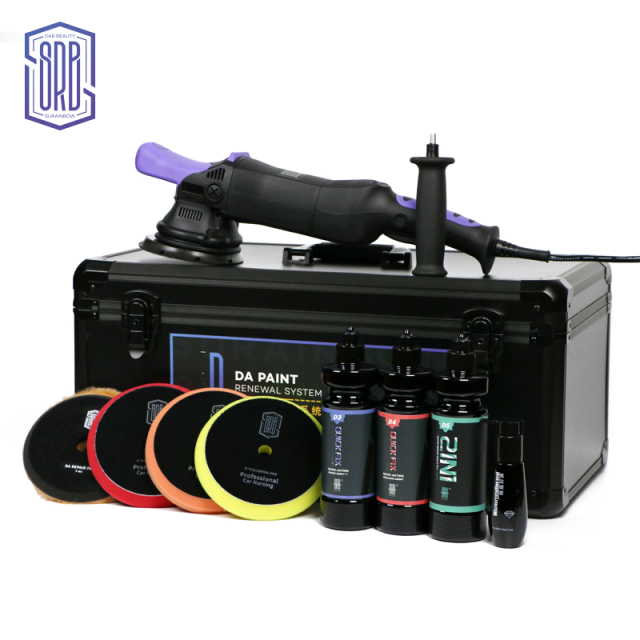
- Smart repair and mobile detailing: one bottle that carries both the cut and the gloss keeps a van kit light, so a single technician can cover most single-panel jobs with a DA machine and two pads.
How to Apply with a DA Polisher
- Panel preparation comes first: wash, decontaminate and dry the surface, then read the defects under a lamp and tape-mark the worst spots so you can find the same places again after the pass.
- Loading the pad and dosing the area: prime the pad, then apply roughly 4-6 grains of material to one working section — the standard dose for this compound, which spreads much further than its volume suggests.
- Machine settings before the compound lands: this car polishing compound is worked with a dual-action polisher between 3-4 on the dial, pad flat on the panel, letting the orbit do the work instead of adding body weight.
- The polishing stroke is a tic-tac-toe: horizontal and vertical passes crossed over each other, arm speed moderate rather than fast, pressure firm and even — fast arms and heavy hands are what leave holograms behind.
- Keep the pad face clean between sections: brush or blow it out after each panel so spent residue does not glaze the pad and quietly dull the cut on the next one.
- Wipe off and inspect under a lamp: remove the residue with a clean microfiber and read the panel at a low angle; only defects that are still visible need another pass.
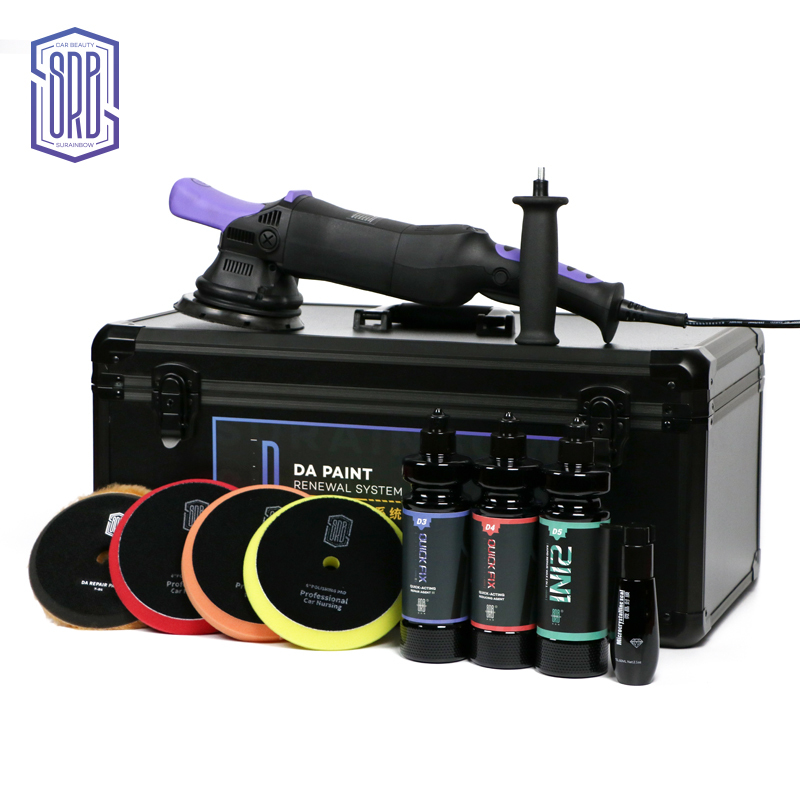
- A quick-effect mirror agent finishes the job: run it after the paint correction to lift the final gloss and make the panel easier to hand over to the customer.
Specifications
| Product name | Surainbow quick polish compound (strong cut) |
| Model | D3 |
| Product type | one step polishing compound (three-in-one) |
| Cut level | Strong cut, heavy to moderate defects |
| Formula base | Water-based restorer |
| Abrasive system | Imported nano abrasive with lubrication technology |
| Silicone and filler | Free of silicone and filler |
| Dust | Dust-free in use |
| Machine and speed | Dual-action polisher, 3-4 on the dial |
| Working area | 50 × 50 cm per application |
| Standard dose | About 4-6 grains per application |
| Sanding mark range | 1500-2000 grit |
| Finish | High-gloss mirror |
| Follow-up | Quick-effect mirror agent recommended |
Batch Records & Quality Control
Every batch is compared with the sample the buyer approved, not with a general description. Appearance, colour and consistency are read side by side with the retained reference; filling and closure performance, leak and seal inspection, label and carton control and an outgoing check all run before the order is released for dispatch.
The batch number printed on the carton ties a delivery back to those records, and a retained sample from the same batch stays on file, so a question raised months later can be answered against the material that actually shipped rather than against a memory of it. As a car polishing compound manufacturer we hold the formula and the batch records in the same place, which is what makes that comparison possible at all.
If your market needs third-party performance documentation or an ingredient declaration beyond the safety data sheet, say so when the order is discussed so the available material can be reviewed with you before production is planned.
Finish Inspection
- Read the panel under one consistent light at a low angle: a swirl or a remaining sanding mark shows up as a change in the reflection rather than in the colour, and ordinary daylight will hide both.
- Go back to the tape marks first: the defects you marked before the pass are the honest test of whether the cut worked, and they are the ones the customer will find if you do not.
- Separate a remaining defect from remaining gloss: a trace of sanding mark means more cut is needed, while a dull patch with no defect usually means the residue was not fully removed — the two need different responses.
- Check the awkward areas: edges, swage lines, door handles, mirror caps and bumper corners take a different pad angle and a different pressure, and they are where haze or a thin edge appears first.
- Judge the panel against the paint beside it: the aim is an area that matches the surrounding finish, not a spot that is glossier than the rest of the car.
- Record the settings that worked: pad, machine speed, number of passes and how long the material stays on the panel all change what a polishing compound for car scratches leaves behind, so the notes from this panel are what make the next one repeatable.
Ordering & Delivery
- Start with a sample: run the compound on one of your own panels before committing to volume, and ask for the current sample terms when you request it.
- Approve the packaging before bulk: label artwork, bottle, closure, carton and shipping marks are proofed and signed off, and the approved proof becomes the reference for the production run.
- Confirm the order in writing: quantity, pack size, destination market and the document set your importer needs — as a strong cutting polish compound supplier we confirm availability and the delivery schedule against that same brief.
- Balance and documents: once the balance and the approved document set are in place, the order is released; a safety data sheet, certificate of analysis and the commercial and customs paperwork can be prepared for the batch, so confirm the exact set your market requires.
- Dispatch: this compound is a stock line, and In stock and fast shipping is how it moves once the order is released, with the shipping method agreed in the order confirmation.
- After-sales and traceability: report leakage, a shortage or a quality concern with the batch number, the affected quantity and clear photos so it can be checked against the batch record for that delivery.
Scale & Supply Capability
We are Guangzhou Liangdian Automotive Supplies Co., Ltd., an integrated manufacturing and trading company founded in Guangzhou in 2010. With 50 employees, we supply a broad range of car care products to distributors, wholesalers and brand owners. Our range lets you source across categories through one supplier, with in-stock options and fast shipping. Alongside our SURAINBOW brand, we offer OEM/ODM customization, supported by a professional R&D team that can design and develop products around your requirements.
FAQ
Can this compound be used by hand, or does it need a DA polisher?
The application guidance is written around a dual-action polisher at 3-4 on the dial, where the compound is at its most predictable — the orbit keeps the abrasive moving evenly and stops a technician leaning on one spot. A small area can be worked by hand if no machine is available, but expect slower cutting and more variation across the panel, so try a small test section before committing to a whole door. Either way, keep the pad flat and let the abrasive do the work.
Does one pass really replace a traditional multi-stage repair?
On a panel where the defects are heavy-to-moderate and the clear coat is sound, yes — that is the job the one step polishing compound was formulated for, and the reason the cut and the gloss come out of the same bottle. Hard clear coats, deep scratches and aggressively sanded areas can still leave a trace after the first pass, and those need a second application or a finer finishing step. The safe way to judge it is to run the full process on one section and inspect it under a lamp before planning a whole car around it.
Will it cut the same on hard and soft paint?
Every polishing compound for car scratches removes a fine amount of clear coat, and how much it removes depends on the paint system as much as on the product. A hard clear coat takes longer to level; a soft one responds quickly and can haze if the machine is held in one place. Pad choice, machine speed, pressure and the time the material spends working all shift the result, so keep a written note of the settings that worked on a given paint system — they will not transfer unchanged to the next one.
Can we order it under our own brand?
Yes. Private-label and OEM routes run alongside the SURAINBOW range, and labels, cartons and artwork can be reviewed for your market. As a strong cutting polish compound supplier we produce against the sample and the packaging proof you approve, so the bulk batch is compared with the material you signed off rather than with a description. The scope that applies to this item — bottle, closure, label language and carton — is confirmed before production starts.
Can the panel be worked in direct sunlight?
Keep the panel cool and out of direct sun while you work. A water-based compound that dries ahead of the pass cuts unevenly, wipes off harder and can leave a patchy finish that reads like a defect in the paint. Work in shade, take one panel at a time, and if the surface is hot from a bake oven or from standing outside, let it come down to a normal working temperature before the pad goes on.